Table of Contents
- What Is Rule 4 of the Federal Rules of Procedure?
- What Is Rule 5 of the Federal Rules of Procedure?
- How Is a Court Summons Served?
- What Is Insufficient Service of Process?
- How Long Do You Have To Serve Someone?
The Federal Rules of Civil Procedure (FRCP) describe what constitutes proper nationwide service of process. The rules also bring some uniformity to federal civil proceedings. Understanding what constitutes service of process in cases involving federal courts is essential to ensuring lawsuits proceed effectively.
But when it comes to service of process, the federal service of process rules are not your only concern. Law firms must also adhere to state laws and regulations regarding serving legal documents to a defendant, which are often more strict.
It’s important that your law firm works closely with experienced process servers who understand all applicable rules inside and out because failing to properly serve a defendant could torpedo your case. That being said, it’s never a bad time for a quick refresher on what some of the FRCP service of process rules are.
What is Rule 4 of the Federal Rules of Procedure?
In civil law, a complaint is the first formal action taken, initiating a lawsuit. The complaint outlines the allegations against the defending party and calls on the court to act. Courts issue a summons in response to a filed complaint. These must be served to the defendant.
Rule 4 of the Federal Rules of Civil Procedure states the process for serving a summons and complaint for a federal civil lawsuit. The rule outlines exactly what a summons must include, who can serve the summons, and how it has to be delivered. It also indicates a 90-day deadline for completion of service after a complaint has been filed. Abiding by Rule 4 helps ensure the defendants are notified properly and are given a fair opportunity to respond. Find out more about the Federal Rules of Civil Procedure.
What are the Federal rules for a Summons?
Under Rule 4(a) of the Federal Rules of Civil Procedure, a summons must meet strict requirements before valid service of process can occur in federal court. Before a summons can be served with the complaint, it must include the following elements:
- The name of the court issuing the summons
- The names of the parties to the case
- A directive specifically naming the defendant(s) being served
- The name and address of the plaintiff’s attorney, or the plaintiff’s address if unrepresented
- A statement of the time limit for the defendant to appear and respond
- A notice that failure to appear may result in a default judgment
- The signature of the court clerk
- The seal of the court
If any amendments need to be made to a summons, the court allows for doing so.
What is Rule 5 of the Federal Rules of Procedure?
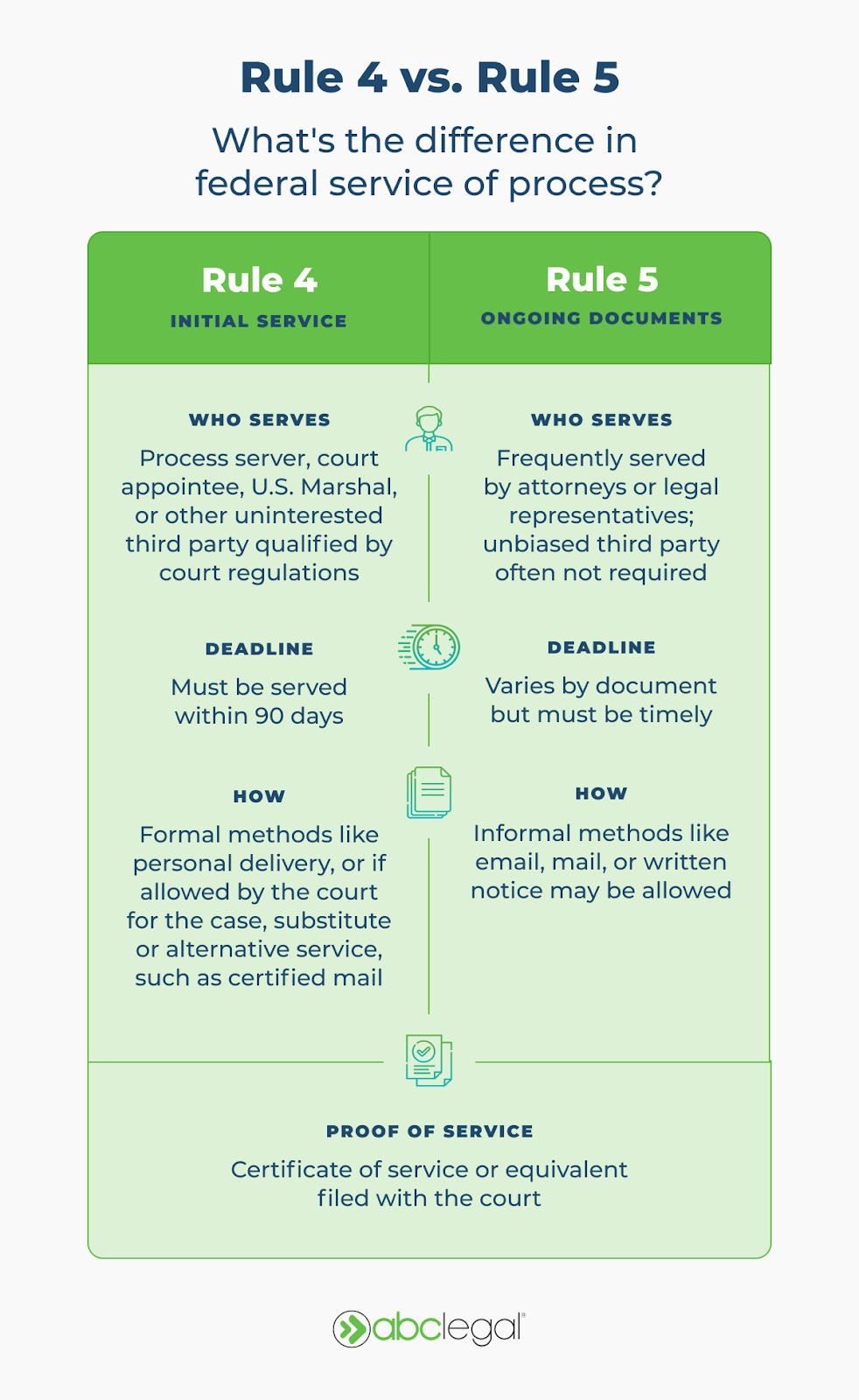
Rule 5 of the service of process federal rules covers how parties need to file and serve documents after the complaint. Rule 5 also indicates when service is required and how service of process is handled (e.g., by hand, mail, or email). The rule further states that served documents must be filed with the court, and proof of service should be made, along with how service was delivered.
Rule 5 is different from Rule 4 in that it applies to serving and filing documents subsequent to the initiation of the lawsuit, which may include less formal methods such as email. Rule 4 is more about serving the initial summons and complaint to initiate a lawsuit via formal methods.
How is a Court Summons Served?
A court summons, along with the complaint, is typically served in person by a process server. It may also be served by a sheriff or another adult not involved in the complaint. A court summons is sometimes served by mail or with a waiver request or as allowed by state law where the case is filed.
Once you, as the plaintiff or party representing the plaintiff, have verified that your summons contains the required information for federal court service of process and the complaint has been filed with the court, you may present the summons to the court’s clerk for signature and seal.
After the clerk signs and seals the summons, it will be issued to the plaintiff or the party representing the plaintiff for service upon the defendant. If multiple defendants are named in the complaint, a separate summons or a copy of the original summons will also be issued to the plaintiff for service on the defendants.
How Does Someone Get Served in the United States?
The service of process federal rules state that, unless a federal law provides otherwise, an individual may be served in a judicial district of the United States by following the state’s laws for service of process where the defendant is located. Service of process may also be completed by:
- Personally delivering a copy of the summons and complaint to the defendant(s)
- Leaving a copy of the summons and complaint at the defendant’s residence with someone of suitable age who also resides at the residence
- Delivering a copy of the summons and complaint to an agent authorized to receive service
It’s important to pay particular attention to the nuances of each state’s laws for service of process. For example, while the FRCP merely states that a summons may be left with someone of “suitable age,” many states specifically address the minimum age of a person who may receive service on behalf of a defendant. In the state of Florida, for example, the minimum age is 15, whereas in California the minimum age is 18.
How Does Someone Get Served in a Foreign Country?
Technology has truly created a global society, and it’s quite possible that a defendant may reside outside of the United States. In these situations, national service of process rules don’t necessarily apply.
The Hague Conventionspells out how service of process is to be carried out in countries that are signatories to the convention. This helps to streamline and speed up foreign service of process. However, if the defendant is residing in a country that is not a signatory to the Hague Convention, things can become much more complicated. You’ll have to look at the service of process laws of the country in question. In such situations, service of process can take up to a year, or even longer.
Who Can Serve a Summons?
In general, a summons may be served by anyone who is at least 18 years of age and is an impartial third party to the case. Alternatively, the plaintiff may request that the service be performed by a United States Marshal or deputy marshal, or by a person specially appointed by the court. Service of process may also be performed by a reputable third-party, such as ABC Legal.
How Do You Get Proof of Service?
Proof of service, also known as a return of service, must be provided to the court unless a defendant has waived service of process. This proof must be provided by the process server, as outlined in Rule 4(l), unless service was made by a United States marshal or deputy marshal.
The return of service typically includes:
- Name of person served
- Date and time served
- Location of service
- Method of service
It is then filed with the court as official documentation. Some jurisdictions may accept electronic service records or certified mail receipts as proof, depending on how service was completed.
Download the eBook to learn how to ensure proper service of process
What Is Insufficient Service of Process?
Insufficient service of process means the legal rules (usually under FRCP Rule 4) were violated. Also referred to as improper service of process, courts may consider service of process insufficient because the defendant was not properly notified of a lawsuit, which can happen if:
- The wrong person was served
- Service of process was late
- Service didn’t follow the required method (e.g., no personal delivery or no signed waiver)
Insufficient service of process can lead to delays or even dismissal of a case.
How Long Do You Have to Serve Someone?
In federal court, a defendant has to be served within 90 days after the complaint has been filed with the court. If the deadline passes, the court–either by motion or acting on its own after informing the plaintiff–may dismiss the complaint without prejudice or issue an order requiring service to be made by an appropriate date. However, if the plaintiff is able to show good cause for why process wasn’t served in the 90-day time period, the court may extend the deadline or allow for an alternative method of service.
While federal rules require that service of process be completed within 90 days of filing a complaint, the actual time it takes to serve process may vary. Some factors are beyond the control of the process server or your legal team, such as the defendant's:
- Location (remote locations or those with gated access)
- Availability to receive documents
- Willingness to accept service
Incorrect or outdated addresses may also delay service, in spite of your best efforts. That’s why the reliability and expertise of the process server matter. An experienced process server should be able to:
- Act quickly
- Make multiple, timely attempts to serve
- Follow the correct legal procedures
- Use tools like skip tracingto locate hard-to-find recipients
To avoid unnecessary delays or risk of dismissal, it’s best to initiate service promptly and work with expert process servers who know how to navigate all aspects of service of process.
Get the Ultimate Guide to Ensuring Proper Service of Process
ABC Legal Helps Ensure Service of Process Federal Rules Are Followed
As you can see, the federal service of process rules can get complicated quickly, so don’t leave your legal document delivery up to chance. ABC Legal has process servers with jurisdictional expertise in all 50 states and 88 countries. Start your serve online now.
Want more ABC Legal expertise?
Find out how we can help grow your firm with fast, efficient, reliable service of process. Request a demotoday.











Learn More

Service of Process From The Ground Up

What Qualifications Does a Registered Process Server Need?
.jpeg?width=500&height=334&name=Why%20you%20shouldn%E2%80%99t%20avoid%20being%20served%20with%20legal%20documents%20(process).jpeg)
Why you shouldn’t avoid being served with legal documents (process)
.jpg?width=1282&height=818&name=iStock-1196084882%20(1).jpg)