
Serving a Summons and Complaint

A complaint opens a lawsuit and lays out the claims; the summons puts the defendant on notice. ABC Legal serves both correctly in all 50 states and backs every attempt with GPS and time-stamped proof.

What is a summons and complaint?

A complaint starts a civil lawsuit and lays out the claims against the defendant. A summons notifies the defendant of the lawsuit and tells them when to respond, and the two are typically served together. Proper service is what establishes the court's personal jurisdiction over the defendant, and if it isn't done correctly, the case can face delays or even dismissal.

The claim

Complaint

The complaint (called a 'petition' in some states) is the plaintiff's written statement of the facts and legal claims: who is being sued, what the defendant allegedly did, and what the plaintiff is asking the court to do. It is the substance of the lawsuit.

The notice

Summons

The summons is the court's official notice to the defendant that a lawsuit has been filed. It states how long the defendant has to respond and warns that failing to do so may result in a default judgment. It is what legally compels the defendant to act.
Terminology varies by state. Texas and Louisiana use 'citation and petition,' while most others use 'summons and complaint.'
The Basics

Why papers need to be served, and who can do it

State_Process_Attempt_D

What is service of process?

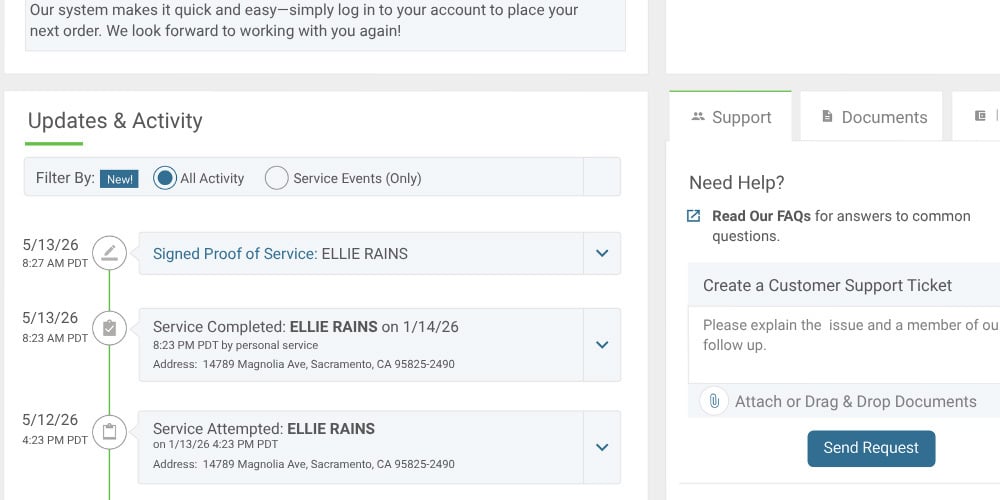
The formal delivery of legal documents to a party in a lawsuit. It is not the same as mailing someone a copy. Service follows rules set by the court, and it has to be documented in a way the court will accept.
State_Process_Attempt_CA

Why do papers have to be served?

Due process. A court cannot enter a binding judgment against someone who was never properly notified of the case. Service is what gives the court personal jurisdiction—and defective service can get a judgment vacated years later.

State_Process_Capture_D

Who can serve my papers?

It depends on the court. Some require a registered or court-appointed process server, or a sheriff. Others allow any adult who is not a party to the case. Using someone unqualified is one of the most common reasons service gets challenged.

What we serve

Every kind of summons and complaint

The variations we see most often across the millions of documents we serve each year.
12,000+ registered servers
SOC2 Type II compliant
DOJ contract since 2003

RULES AND PROCESS EXPERTS

Example summons and complaint rules, state by state

A few examples of how summons and complaint service works by state — ABC serves nationwide, in all 50 states.
California Statewide
Law details
California allows a summons to be served by any person who is at least 18 years of age and not a party to the action (Code Civ. Proc. § 414.10). Personal service is made under § 415.10 'by personal delivery of a copy of the summons and of the complaint to the person to be served.' If the summons and complaint cannot with reasonable diligence be personally delivered, substituted service is authorized under § 415.20 by leaving a copy at the person's office (with the person apparently in charge) or at the dwelling house, usual place of abode, usual place of business, or usual mailing address in the presence of a competent member of the household or a person apparently in charge who is at least 18 years old, and thereafter mailing a copy of the summons and complaint to the person to be served; such service is 'deemed complete on the 10th day after the mailing' (§ 415.20(a), (b)). A corporation is served under § 416.10 by delivering to the person designated as agent for service of process, or to specified officers such as the president, chief executive officer, other head of the corporation, a vice president, a secretary or assistant secretary, treasurer, or general manager. Proof of service is generally made by the server's affidavit/return under § 417.10.
Florida Statewide
Law details
Florida original process is served by a sheriff or a special process server appointed by the sheriff (§ 48.021), or by a certified process server (§ 48.27). Under § 48.031(1)(a), service is made 'by delivering a copy of it to the person to be served with a copy of the complaint, petition, or other initial pleading or paper or by leaving the copies at his or her usual place of abode with any person residing therein who is 15 years of age or older and informing the person of their contents.' A domestic corporation or registered foreign corporation is served under § 48.081 first on its registered agent. If the corporation ceases to have a registered agent, or if the registered agent cannot be served after at least one good-faith attempt because of noncompliance with applicable statutory requirements, service may be made on listed officers ('The chair of the board of directors, the president, any vice president, the secretary, or the treasurer') or a person publicly listed on the latest annual report, with substitute service on the Secretary of State available after due diligence. A domestic or registered foreign limited liability company is served under § 48.062 first on its registered agent, then (after a failed attempt) on any manager of a manager-managed company or any member of a member-managed company (or persons listed on the latest annual report), and ultimately on the Secretary of State after due diligence. The person serving must note on the first page of at least one process served the date and time of service, his or her initials or signature, and, if applicable, his or her identification number (§ 48.031).
Illinois Statewide
Law details
Under 735 ILCS 5/2-202, process is served by a sheriff (or by a coroner if the sheriff is disqualified), and may also be served by a licensed private detective or its registered employees, by civilian personnel employed by a sheriff in a county with a population of less than 2,000,000, or by a private person specially appointed by the court who is over 18 and not a party to the action. An individual is served under 735 ILCS 5/2-203(a) '(1) by leaving a copy of the summons with the defendant personally,' or (2) by leaving a copy 'at the defendant's usual place of abode, with some person of the family or a person residing there, of the age of 13 years or upwards,' informing that person of the contents and also mailing a copy in a sealed, postage-prepaid envelope addressed to the defendant at that abode; the officer or person making service must record details of the person served, address, and date/time in the certificate or affidavit of service or in a record maintained by the sheriff's office or server's employer (§ 2-203(b)). A private corporation is served under 735 ILCS 5/2-204 by leaving a copy of the process with its registered agent or any officer or agent of the corporation found anywhere in the State, or in any other manner now or hereafter permitted by law. A limited liability company is served under 805 ILCS 180/1-50 on its appointed registered agent, and whenever the registered agent 'cannot with reasonable diligence be found' at the registered office or at the principal place of business stated in the articles of organization, the Secretary of State becomes the LLC's agent for service, with copies mailed to the LLC and an affidavit of compliance filed.
New York Statewide
Law details
Under CPLR 308, personal service on a natural person is made by (1) delivering the summons within the state to the person to be served, or (2) delivering it to 'a person of suitable age and discretion at the actual place of business, dwelling place or usual place of abode' and mailing a copy to the person, with the delivery and mailing made 'within twenty days of each other,' proof filed within twenty days of whichever occurs later, and service 'complete ten days after such filing.' Where service under (1) or (2) cannot be made with due diligence, CPLR 308(4) permits 'nail and mail' -- affixing the summons to the door of the actual place of business, dwelling place, or usual place of abode and mailing a copy -- and CPLR 308(5) allows service in a manner the court directs on motion when the other methods are impracticable. A corporation is served under CPLR 311(a)(1) by delivering the summons 'to an officer, director, managing or general agent, or cashier or assistant cashier or to any other agent authorized by appointment or by law to receive service.' A limited liability company is served under CPLR 311-a by delivering a copy to any member (if member-managed), any manager (if manager-managed), any authorized agent, or any person the LLC designated to receive process, and service may also be made under the Limited Liability Company Law. Except where otherwise prescribed by law or court order, papers may be served by any non-party who is 18 or older (CPLR 2103(a)).
Texas Statewide
Law details
Under Tex. R. Civ. P. 103, process 'may be served anywhere by (1) any sheriff or constable or other person authorized by law, (2) any person authorized by law or by written order of the court who is not less than eighteen years of age, or (3) any person certified by the Judicial Branch Certification Commission,' and no person who is a party to or interested in the outcome of the suit may serve process. On filing of the petition the clerk, when requested, issues the citation (Rule 99), which must direct the defendant to file a written answer 'on or before 10:00 a.m. on the Monday next after the expiration of twenty days after the date of service.' Under Rule 106(a), unless the citation or a court order directs otherwise, the citation must be served by (1) delivering to the defendant, in person, a copy of the citation (showing the delivery date) and of the petition, or (2) mailing a copy to the defendant by registered or certified mail, return receipt requested. On a motion supported by a statement made under oath or penalty of perjury that states the facts showing service under 106(a) has been attempted and was unsuccessful, Rule 106(b) allows the court to authorize substitute service by leaving the papers 'with anyone older than sixteen' at a specified location, or 'in any other manner, including electronically by social media, email, or other technology,' reasonably effective to give notice. Rule 107 requires the server to complete a return of service; a return signed by someone other than a sheriff, constable, or clerk must be verified or signed under penalty of perjury, and no default judgment may be granted until proof of service has been on file with the clerk at least ten days (exclusive of the filing and judgment days).
United States District Courts (Federal) Federal (nationwide)
Law details
Under Fed. R. Civ. P. 4(c)(2), 'Any person who is at least 18 years old and not a party may serve a summons and complaint,' so a U.S. marshal is not required for an ordinary summons (the court may specially appoint a marshal and must do so when the plaintiff is authorized to proceed in forma pauperis under 28 U.S.C. § 1915 or as a seaman under 28 U.S.C. § 1916 under Rule 4(c)(3)). An individual within a judicial district of the United States is served under Rule 4(e) by (1) delivering a copy of the summons and of the complaint to the individual personally, (2) leaving a copy of each 'at the individual's dwelling or usual place of abode with someone of suitable age and discretion who resides there,' or (3) delivering a copy to an agent authorized by appointment or by law; Rule 4(e)(1) also allows following the service law of the state where the district court is located or where service is made. A corporation, partnership, or association is served under Rule 4(h)(1)(B) by delivering the summons and complaint 'to an officer, a managing or general agent, or any other agent authorized by appointment or by law to receive service of process.' Proof of service is governed by Rule 4(l): except for service by a United States marshal or deputy marshal, 'proof must be by the server's affidavit.' Rule 4(m) generally requires that service be made within 90 days after the complaint is filed, and Rule 4(d) authorizes a waiver-of-service procedure.
These are examples, not a complete list. The information on this page is provided for general informational purposes only and is not legal advice. Statutes and court rules change, and their application varies by case and venue — verify current requirements with the applicable court or consult a licensed attorney. Statutory references on this page were last reviewed September, 2026.

See your price for service of process

With flat-rate pricing and nationwide coverage, it's easy to see what service of process will cost. Select your state to get started.

Select your state*

Or click any state on the map.

  • Preferred Partner of Wolters Kluwer / CT Corp
  • Exclusive contract with the U.S. Dept. of Justice since 2003
  • Chosen by 50,000+ legal professionals

Some markets require wet ink and may take additional time. Final price available during checkout.

Working against a filing deadline?

Priority moves your serve up the queue — first attempt within 3 days, for $30 more per party.

Commonly asked questions

Summons and Complaint FAQs

What is service of process?
Service of process is the formal delivery of legal documents to a party in a lawsuit, using a method authorized for the case. The delivery must follow the applicable rules and be documented in a way the court will accept, or it may not count. ABC Legal handles both the delivery and the proof that goes with it, helping you get service done right the first time.
Why do papers have to be served?
It comes down to due process: parties need proper notice of a case and an opportunity to respond. Valid service of process helps establish the court's authority over the defendant, and defective service can cause a case to stall or put a judgment at risk. ABC Legal makes service provable, with documented proof of who was served, when, where, and how.
Who can serve my papers?
It depends on the jurisdiction and the type of papers being served. Some require a registered or court-appointed process server or a sheriff, while others allow any adult who isn't a party to the case to make the delivery. Using someone who doesn't qualify can make the service subject to challenge, so ABC Legal uses vetted process servers who meet applicable requirements, with more than 12,000 of them across the country.
How much does it cost to serve a summons and complaint?
ABC Legal uses flat-rate pricing, so you know the cost up front with no mileage charges and no per-attempt fees, and court-ready proof of service is always included. Priority and rush options are available when you need a faster first attempt. The exact rate depends on the service level and the number of parties and addresses, and you'll see it before you place the order.
How long does it take to serve a summons and complaint?
Standard service makes a first attempt within a few days, and rush options move faster when a deadline is tight. Total time depends on how easily the defendant can be located, whether the address is current, and how many attempts it takes. With ABC Legal, every attempt is GPS- and time-stamped, so you can follow progress in your account instead of waiting and wondering.
What if the defendant can't be located?
ABC Legal documents every attempt and uses skip tracing to track down defendants who are hard to find or difficult to serve. If personal delivery still isn't possible, other methods of service may be available depending on the jurisdiction and circumstances, such as leaving the papers with someone at the home or workplace, or service by publication when permitted. ABC Legal can help you pursue the method permitted for your case.
What is the difference between a summons and a complaint?
The complaint lays out the plaintiff's claim: who is being sued, what they allegedly did, and what the plaintiff is asking the court to do. The summons is the court's official notice that the lawsuit exists and states the deadline to respond. They're typically served together, and ABC Legal delivers both as a set, so nothing is missing when the case moves forward.
What proof of service will I receive?
ABC Legal returns a court-ready affidavit or declaration of service showing the date, time, location, and manner of service, formatted to your court's requirements. It's backed by GPS data and, where the court permits, photos from the attempt. You can download the proof from your secure ABC Legal account as soon as service is complete.

Ready to serve a summons and complaint?

Upload your documents in under two minutes. We dispatch a registered local server and keep you updated at every attempt.
Questions? Call (206)-521-2885 — Mon-Fri, 7am-4pm PT.