



The directive
The notice

The formal delivery of legal documents to a party in a lawsuit. It is not the same as mailing someone a copy. Service follows rules set by the court, and it has to be documented in a way the court will accept.
Due process. A court cannot enter a binding judgment against someone who was never properly notified of the case. Service is what gives the court personal jurisdiction—and defective service can get a judgment vacated years later.

It depends on the court. Some require a registered or court-appointed process server, or a sheriff. Others allow any adult who is not a party to the case. Using someone unqualified is one of the most common reasons service gets challenged.
What we serve
A temporary restraining order restricts conduct immediately, often before the other side has appeared in the case. Under the federal rules it binds only those who receive actual notice of it, which is why prompt, documented delivery matters.
Serve a temporary restraining order →A protective order restricts contact or conduct to protect a person from harm. Law enforcement serves these free of charge to the petitioner in several states, and some states let the petitioner elect a private process server instead.
Serve a protective order →An order to show cause requires a party to appear and explain why the court should not take a requested action. Federal courts treat it as a paper served on parties rather than original process.
Serve an order to show cause →A contempt order follows a finding that a party violated a court order and sets the consequence. Federal service of orders in civil contempt proceedings has its own territorial limits under Rule 4.1(b).
Serve a contempt order →An order after hearing replaces a temporary order with a longer-term one once both sides have been heard. Some states permit first-class mail service when the respondent was personally served with the temporary order and did not appear.
Serve an order after hearing →An injunction orders a party to stop or start doing something, either temporarily or permanently. Enforceability turns on actual notice, so the proof of service is what makes the injunction usable.
Serve an injunction →Nationally Trusted Performance
Secure case entry into our encrypted infrastructure
Initial audit ensures legal paperwork is court-ready
Validation against specific state and county statutes
Case matched with a vetted local professional
Real-time digital dispatch to the field professional's mobile app
Fieldwork starts with GPS-tracked service tries
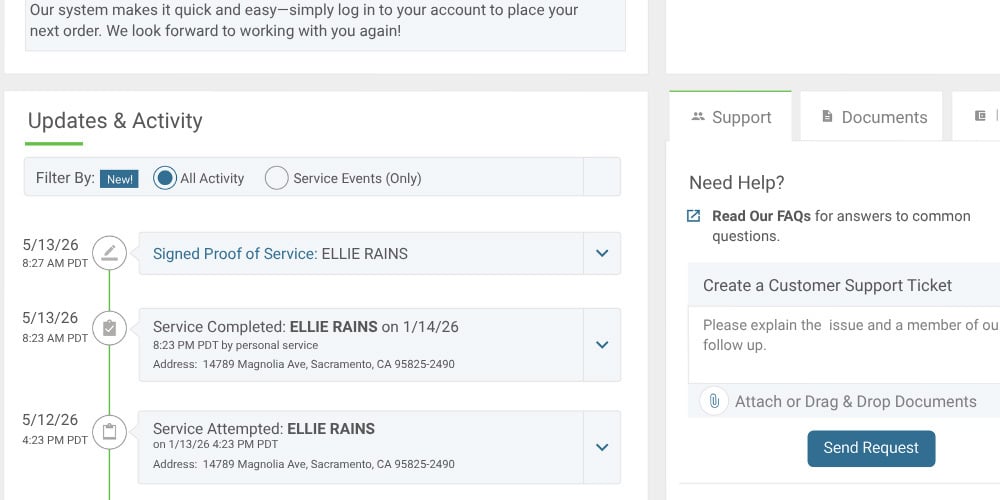
Evidence of effort is uploaded and timestamped
Proof of Service or Non-Service generated
Expert audit of all proofs for absolute accuracy
Everything archived in your secure dashboard
RULES AND PROCESS EXPERTS
Select your state*
Or click any state on the map.
Some markets require wet ink and may take additional time. Final price available during checkout.

Priority moves your serve up the queue — first attempt within 3 days, for $30 more per party.

Commonly asked questions




NV PILB LIC#3022