
Serving a notice

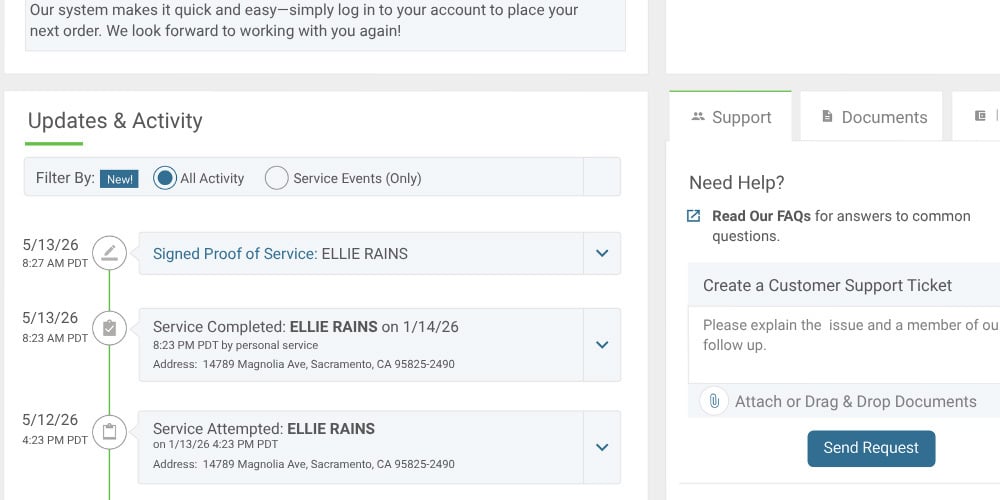
Some court notices must be delivered in the field or posted at the property, and getting one wrong can stall a case. ABC Legal serves court notices nationwide, with GPS- and time-stamped proof on every attempt.

Which notices require service of process?

A notice tells someone that something has happened or is about to happen in a case. The rules split along a clean line: notices directed at people already in the lawsuit are served on their attorney by mail or electronic filing, while notices tied to seizing property, foreclosing on a home, or opening a proceeding involve field delivery and often a third-party process server.

Field work

Notices that are served

A notice of levy is served by the levying officer or, in California, by a registered process server who may levy directly. Washington's foreclosure notice of default must be mailed (first-class and certified) and then either posted conspicuously on the premises or personally served on the borrower and grantor. A notice of hearing bundled with an initial petition rides along with the petition and follows the summons rules.

Filed and mailed

Notices that are not

A notice of motion, notice of deposition, and notice of appeal are served on parties already in the case. Under the federal rules, Texas Rule 21a, and New York's CPLR 2103, these go to the attorney of record by mail or through the court's electronic filing system. Texas actually requires e-service when the paper is e-filed. A process server is permitted in some states but is not required.
A process server is permitted for most notices but legally required for very few. ABC Legal serves the ones that do require it, such as notices tied to property, foreclosure, or opening a proceeding, nationwide.
The Basics

Why papers need to be served, and who can do it

State_Process_Attempt_D

What is service of process?

The formal delivery of legal documents to a party in a lawsuit. It is not the same as mailing someone a copy. Service follows rules set by the court, and it has to be documented in a way the court will accept.
State_Process_Attempt_CA

Why do papers have to be served?

Due process. A court cannot enter a binding judgment against someone who was never properly notified of the case. Service is what gives the court personal jurisdiction—and defective service can get a judgment vacated years later.

State_Process_Capture_D

Who can serve my papers?

It depends on the court. Some require a registered or court-appointed process server, or a sheriff. Others allow any adult who is not a party to the case. Using someone unqualified is one of the most common reasons service gets challenged.

What we serve

Every kind of notice

The variations we see most often across the millions of documents we serve each year.

Notice of motion

A notice of motion tells the other parties a motion has been filed and when it will be heard. Because everyone is already in the case, it goes to each party's attorney of record by mail or e-filing, so a process server isn't needed.

Notice of deposition

A notice of deposition sets the time and place for testimony. Like a notice of motion, it goes to the parties by mail or e-filing. Compelling a non-party takes a deposition subpoena, not this notice.

12,000+ registered servers
SOC2 compliant
DOJ contract since 2003

RULES AND PROCESS EXPERTS

Example notice rules, state by state

A few examples of how notice service works by state — ABC serves nationwide, in all 50 states.
California Statewide
Law details
This is the notice category that genuinely is process server work. At the time of levy or promptly after, the levying officer must serve the judgment debtor with the writ of execution, a notice of levy, the Judicial Council exemption forms, and any affidavit of identity, personally or by mail. Section 699.080 authorizes a registered process server to levy under a writ of execution on nine categories of property and requires that server to comply with the levy, posting, and service provisions of the article—meaning to serve the notice of levy itself. The process server's fee is a recoverable cost.
New York Statewide
Law details
Papers served on a party in a pending action go to that party's attorney, by personal delivery to the attorney, by mail (complete on mailing, plus five days added in state), by leaving them at the attorney's office, by fax to a designated number, by overnight delivery, or by electronic means through NYSCEF. Section 2103(a) does allow service by any person not a party who is 18 or over, so a process server is permitted—but for a notice of motion or deposition on an appearing adversary, mail or e-filing is the norm and no process server is required.
Texas Statewide
Law details
Rule 21a covers every notice required by the rules other than the citation issued when a suit is filed. If the document is e-filed and the recipient's email is on file with the electronic filing manager, service must be electronic through that system; otherwise it may be served in person, by mail, by commercial delivery, by fax, or by email. Rule 21a(d) allows service by a party, an attorney of record, a sheriff or constable, or any other person competent to testify—so a process server may serve a Texas notice, but is rarely needed because e-service is mandatory for e-filed papers.
United States District Courts Federal
Law details
Once a case is underway, a written motion and any written notice, appearance, demand, or offer of judgment must be served on every party—but under Rule 5(b) that service is made on the party's attorney, and may be done by mail (complete on mailing), by hand, or by filing it in the court's electronic filing system, which serves every registered user automatically. In practice a notice of motion, deposition, or appeal in federal court is served by the filing attorney's own office. No process server is involved. Rule 5(a)(2) is the narrow exception: a pleading asserting a new claim against a defaulted party goes back out under Rule 4.
Washington Statewide
Law details
At least 30 days before a notice of sale is recorded, the beneficiary or trustee must send the written notice of default to the borrower and grantor by both first class and registered or certified mail, return receipt requested—and, on top of that mailing, must either post a copy in a conspicuous place on the premises or personally serve it on the borrower and grantor. That second step is genuine field work. The later notice of trustee's sale under RCW 61.24.040 is recorded with the county auditor, mailed, published twice in a legal newspaper, and posted on the property, with service on an occupant available in lieu of posting.
These are examples, not a complete list. The information on this page is provided for general informational purposes only and is not legal advice. Statutes and court rules change, and their application varies by case and venue — verify current requirements with the applicable court or consult a licensed attorney. Statutory references on this page were last reviewed September, 2026.

See your price for service of process

With flat-rate pricing and nationwide coverage, it's easy to see what service of process will cost. Select your state to get started.

Select your state*

Or click any state on the map.

  • Preferred Partner of Wolters Kluwer / CT Corp
  • Exclusive contract with the U.S. Dept. of Justice since 2003
  • Chosen by 50,000+ legal professionals

Some markets require wet ink and may take additional time. Final price available during checkout.

Working against a filing deadline?

Priority moves your serve up the queue — first attempt within 3 days, for $30 more per party.

Commonly asked questions

Notice FAQs

What is service of process?
Service of process is the formal delivery of legal documents to a party in a lawsuit, using a method authorized for the case. The delivery must follow the applicable rules and be documented in a way the court will accept, or it may not count. ABC Legal handles both the delivery and the proof that goes with it, helping you get service done right the first time.
Why do papers have to be served?
It comes down to due process: parties need proper notice of a case and an opportunity to respond. Valid service of process helps establish the court's authority over the defendant, and defective service can cause a case to stall or put a judgment at risk. ABC Legal makes service provable, with documented proof of who was served, when, where, and how.
Who can serve my papers?
It depends on the jurisdiction and the type of papers being served. Some require a registered or court-appointed process server or a sheriff, while others allow any adult who isn't a party to the case to make the delivery. Using someone who doesn't qualify can make the service subject to challenge, so ABC Legal uses vetted process servers who meet applicable requirements, with more than 12,000 of them across the country.
Which court notices require service of process?
It splits along a fairly clean line. Notices aimed at people already in the case, like a notice of motion, deposition, or hearing, usually go to the attorney of record by mail or e-filing and don't need a process server. Notices tied to seizing property, foreclosure, or opening a new proceeding involve field delivery or posting, and that's the work ABC Legal handles.
Do you serve a notice of motion or deposition?
Those are typically served on the parties already in the case through their attorney of record, by mail or the court's e-filing system, so a process server usually isn't required. A subpoena, not a notice, is what compels a non-party to appear for a deposition. If your matter does call for field service, ABC Legal can handle it nationwide.
What is a notice of levy or foreclosure notice?
These are the notices that genuinely need field work. A notice of levy tells the debtor and the property holder that specific property has been seized toward a judgment. A foreclosure notice of default usually has to be mailed and then either posted conspicuously on the property or personally served, depending on the state. ABC Legal serves and documents both.
Do all court notices need a process server?
No. Notices to parties already in a case, like a notice of motion, deposition, or appeal, usually go to counsel by mail or e-filing, while notices tied to property, foreclosure, or opening a proceeding are the ones that require field service. ABC Legal serves the notices that need it, nationwide, with documented proof.
What proof do I get?
ABC Legal returns a court-ready proof of service showing how and when the notice was delivered, formatted for your court and backed by GPS and time-stamped notes wherever field service was required. It's available in your secure ABC Legal account.

Ready to serve a court notice?

Upload your documents in under two minutes. We dispatch a registered local server and keep you updated at every attempt.
Questions? Call (206)-521-2885 — Mon-Fri, 7am-4pm PT.