
Serving a Writ of Garnishment

Garnishment usually takes two separate deliveries: the writ to the employer or bank holding the money, and a separate exemption notice to the debtor. ABC Legal handles both and serves garnishment documents nationwide through 12,000+ vetted local process servers.

What is a writ of garnishment?

A writ of garnishment directs a third party who holds money belonging to a judgment debtor, usually an employer or a bank, to turn it over toward the judgment. Every garnishment statute pairs that writ with a notice to the debtor explaining their exemption rights, and courts treat both deliveries as mandatory. Which one goes first, and by what method, is set by state law and varies more than almost any other document type.

To the garnishee

The writ

The writ is served on the employer or financial institution that holds the funds. Details matter here: Washington requires a named branch and delivery to a manager, cashier, or assistant cashier to reach deposits, Florida routes service to the registered agent first, and New York expressly bars serving an employer through an agent designated outside Rule 318.

To the debtor

The exemption notice

The judgment debtor must be told what income or property is protected and how to claim it. Washington requires certified mail or personal service on or within two days of serving the garnishee. Florida requires first class mail within a set window. In California, the employer, not a process server, hands the exemption packet to the employee within 10 days.
Texas bars garnishment of current wages for most consumer debts under its constitution, so Texas garnishment work is bank and asset garnishment, not wage garnishment.
The Basics

Why papers need to be served, and who can do it

State_Process_Attempt_D

What is service of process?

The formal delivery of legal documents to a party in a lawsuit. It is not the same as mailing someone a copy. Service follows rules set by the court, and it has to be documented in a way the court will accept.
State_Process_Attempt_CA

Why do papers have to be served?

Due process. A court cannot enter a binding judgment against someone who was never properly notified of the case. Service is what gives the court personal jurisdiction—and defective service can get a judgment vacated years later.

State_Process_Capture_D

Who can serve my papers?

It depends on the court. Some require a registered or court-appointed process server, or a sheriff. Others allow any adult who is not a party to the case. Using someone unqualified is one of the most common reasons service gets challenged.

What we serve

Every kind of garnishment

The variations we see most often across the millions of documents we serve each year.
12,000+ registered servers
SOC2 Type II compliant
DOJ contract since 2003

RULES AND PROCESS EXPERTS

Example garnishment rules, state by state

A few examples of how garnishment service works by state — ABC serves nationwide, in all 50 states.
California Statewide
Law details
California wage garnishment is a sheriff-or-marshal-only process—levying officer is defined as the sheriff or marshal, and section 706.103(a) requires that officer to serve the employer. A private process server cannot serve an Earnings Withholding Order. The levying officer serves the employer with a five-document packet including the order, the employer's return, the notice to employee, and the claim of exemption and financial statement forms. The judgment debtor is never served by anyone official—section 706.104 makes the employer the delivery mechanism, requiring it to hand the debtor the order and exemption forms within 10 days, and to mail its return to the levying officer within 15 days.
Florida Statewide
Law details
Where the garnishee is a corporate employer or bank, service goes to the entity's registered agent; only after a failed good-faith attempt may an officer or a person listed on the latest annual report be served, with the Secretary of State as a further fallback. The judgment debtor is not personally served—the clerk attaches a statutory notice with the claim of exemption form, and the plaintiff must mail it first class, with copies of the writ and motion, within five business days after issuance or three business days after the garnishee is served, whichever is later. If that mail is returned undeliverable the plaintiff must re-mail to the defendant's place of employment. Section 77.055 separately requires the plaintiff to forward the garnishee's answer to the debtor with notice of the 20-day right to move to dissolve.
New York Statewide
Law details
New York inverts the usual order and the sheriff is mandatory at the front end. The income execution is delivered to the sheriff of the debtor's county of residence, and within 20 days the sheriff—not a private process server—must serve it on the judgment debtor first, either like a summons or by certified mail return receipt requested with an additional copy by regular mail. Only if the debtor then defaults for 20 days, or the sheriff cannot serve the debtor within 20 days, does the sheriff serve the garnishee employer. Section 5231(e) provides that service on the employer may not be made by delivery to a person authorized to receive a summons solely by a designation filed outside Rule 318—so serving the ordinary registered agent is not good enough.
Texas Statewide
Law details
Read the constitutional limit first: no current wages for personal service are ever subject to garnishment except for enforcement of court-ordered child support or spousal maintenance. Ordinary judgment creditors therefore cannot garnish Texas wages at all, so Texas garnishment is about bank accounts and other non-wage property. Service on the garnishee follows ordinary citation practice. The judgment debtor is served under Rule 663a as provided in Rule 21a or Rule 501.4—meaning mail, commercial delivery, e-service, or personal service, not mandatory personal service—and Rule 679b requires the creditor to serve the protected property notice and claim form within three business days of learning property was frozen.
Washington Statewide
Law details
Service on the garnishee has three co-equal routes: certified mail return receipt requested, the sheriff of the garnishee's county, or any person qualified to serve process—the sheriff is never mandatory. The writ is invalid unless served together with the blank answer form and, for non-continuing writs, a $20 payment to the garnishee. Bank, savings and loan, and credit union garnishees are different: the writ must name a specific branch to reach deposits, and service must be by certified mail or personal delivery on the manager, cashier, or assistant cashier. The judgment debtor gets a separate track—on or before the day the garnishee is served, the creditor must mail the writ, affidavit, and exemption forms by certified mail, or personally serve them within two days after serving the garnishee.
These are examples, not a complete list. The information on this page is provided for general informational purposes only and is not legal advice. Statutes and court rules change, and their application varies by case and venue — verify current requirements with the applicable court or consult a licensed attorney. Statutory references on this page were last reviewed September, 2026.

See your price for service of process

With flat-rate pricing and nationwide coverage, it's easy to see what service of process will cost. Select your state to get started.

Select your state*

Or click any state on the map.

  • Preferred Partner of Wolters Kluwer / CT Corp
  • Exclusive contract with the U.S. Dept. of Justice since 2003
  • Chosen by 50,000+ legal professionals

Some markets require wet ink and may take additional time. Final price available during checkout.

Working against a filing deadline?

Priority moves your serve up the queue — first attempt within 3 days, for $30 more per party.

Commonly asked questions

Garnishment FAQs

What is service of process?
Service of process is the formal delivery of legal documents to a party in a lawsuit, using a method authorized for the case. The delivery must follow the applicable rules and be documented in a way the court will accept, or it may not count. ABC Legal handles both the delivery and the proof that goes with it, helping you get service done right the first time.
Why do papers have to be served?
It comes down to due process: parties need proper notice of a case and an opportunity to respond. Valid service of process helps establish the court's authority over the defendant, and defective service can cause a case to stall or put a judgment at risk. ABC Legal makes service provable, with documented proof of who was served, when, where, and how.
Who can serve my papers?
It depends on the jurisdiction and the type of papers being served. Some require a registered or court-appointed process server or a sheriff, while others allow any adult who isn't a party to the case to make the delivery. Using someone who doesn't qualify can make the service subject to challenge, so ABC Legal uses vetted process servers who meet applicable requirements, with more than 12,000 of them across the country.
Who is a garnishment served on?
Usually two people. The writ of garnishment goes to the garnishee that holds the money, such as an employer for wages or a bank for an account, ordering it to withhold and to answer under oath. A separate exemption notice goes to the debtor explaining what's protected. Both deliveries are mandatory in most states, and ABC Legal handles both so the garnishment isn't voided on a technicality.
Can wages be garnished in every state?
No. Texas bars garnishing current wages for most consumer debts under its state constitution, so garnishment there targets bank accounts and other non-wage property. Elsewhere, federal and state law cap how much of a paycheck can be withheld and protect a portion of it. ABC Legal knows which rules apply where and serves the garnishment accordingly.
What is the exemption notice?
It's the notice that tells the judgment debtor which income or property is protected and how to claim that protection. States set strict methods and deadlines for it, and Washington, for example, requires certified mail or personal service on or within two days of serving the garnishee. Missing that step can undo the garnishment, so ABC Legal serves and documents the exemption notice on time.
How is a bank garnishment served?
On the financial institution holding the funds, and the details matter. Some states require naming a specific branch and delivering to a manager, cashier, or assistant cashier to actually reach the deposits. ABC Legal serves the garnishee the right way so the hold takes effect and withholding can begin.
What proof do I get?
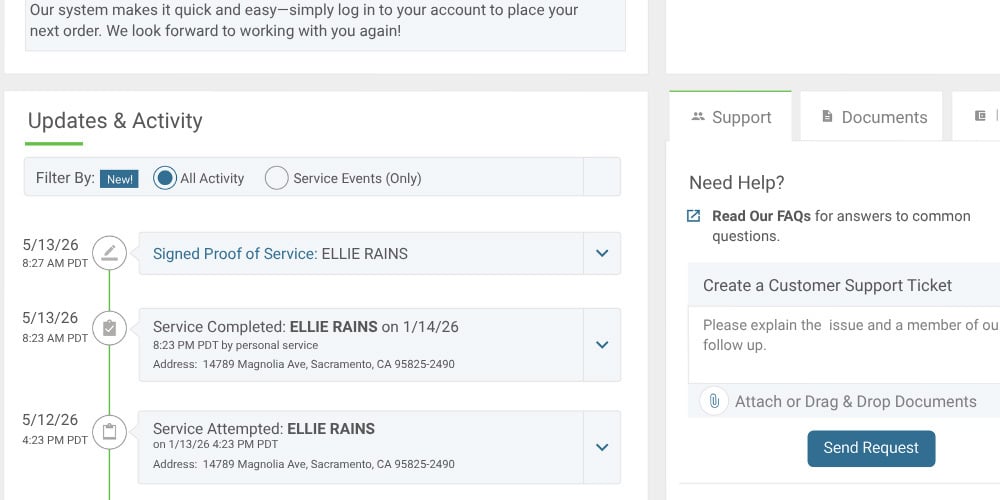
ABC Legal provides proof of service showing the garnishee was served, when, and how, which is the event that starts the garnishment period, plus proof of the exemption notice to the debtor. Everything is documented and available in your secure ABC Legal account.

Ready to serve a garnishment?

Upload your documents in under two minutes. We dispatch a registered local server and keep you updated at every attempt.
Questions? Call (206)-521-2885 — Mon-Fri, 7am-4pm PT.