
Serving Family Law Documents

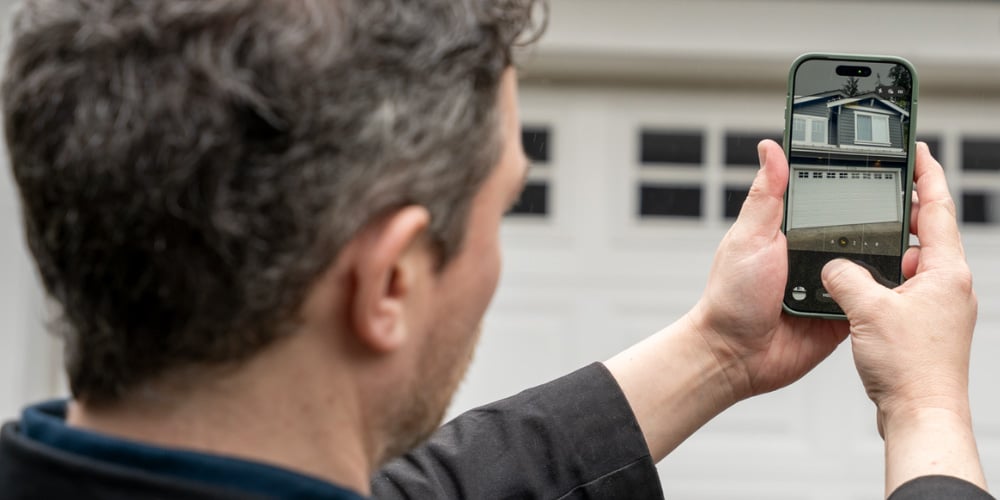
Family law papers usually travel together, and the whole set has to arrive complete. ABC Legal serves family law documents nationwide with discretion, documenting every attempt with photos, GPS, and a time stamp.

How are family law documents served?

A divorce, custody, paternity, or child support case opens the same way any civil case does: with an initial document that asks the court to act, such as a complaint, notice, or petition. Once the court accepts that filing, it usually issues a document calling the parties to court, such as a summons, order, or citation, and everyone involved must be given notice by receiving both. Most states require an unbiased party who isn't involved in the lawsuit to deliver the documents. Certain documents, like protective orders, may require a court official or law enforcement to complete delivery.

The filing

Petition and summons

In family law cases, the petition sets out what the plaintiff or requestor is asking the court to decide or do regarding another party, and the summons or citation notifies that party and sets a deadline to respond. The two are served as a set; both must be delivered for the notification to count and the case to move forward.

Protective orders

A separate track

Domestic relations protective orders may be handled differently from a petition. California, Washington, and New York all provide that law enforcement serves the order without charging the petitioner, and Washington requires law enforcement service outright in cases involving firearm surrender, transfer of child custody, vacating a shared residence, or an incarcerated respondent. Florida bars anyone but a law enforcement officer from serving certain injunctions.
Personal service is the standard for the initial petition, but the petitioner may not serve their own papers. An uninterested adult or a registered process server must do it.
The Basics

Why papers need to be served, and who can do it

State_Process_Attempt_D

What is service of process?

The formal delivery of legal documents to a party in a lawsuit. It is not the same as mailing someone a copy. Service follows rules set by the court, and it has to be documented in a way the court will accept.
State_Process_Attempt_CA

Why do papers have to be served?

Due process. A court cannot enter a binding judgment against someone who was never properly notified of the case. Service is what gives the court personal jurisdiction—and defective service can get a judgment vacated years later.
State_Process_Capture_D

Who can serve my papers?

It depends on the court. Some require a registered or court-appointed process server, or a sheriff. Others allow any adult who is not a party to the case. Using someone unqualified is one of the most common reasons service gets challenged.

What we serve

Every kind of family law

The variations we see most often across the millions of documents we serve each year.
12,000+ registered servers
SOC2 Type II compliant
DOJ contract since 2003

RULES AND PROCESS EXPERTS

Example family law rules, state by state

A few examples of how family law service works by state — ABC serves nationwide, in all 50 states.
California Statewide
Law details
The dissolution petition and Judicial Council summons are served in the same manner as papers in civil actions generally—personal delivery, by any person at least 18 who is not a party. The petitioner cannot serve their own papers; a registered process server, the sheriff, or any competent adult non-party may. A joint petition is deemed served on filing. For a domestic violence restraining order, section 6383 provides that the order shall, on request of the petitioner, be served by a law enforcement officer, and a fee shall not be charged to the petitioner for service of an order. Law enforcement is not exclusive—private service under the general civil rules above remains available. If personal service can't be achieved and the court finds the respondent is evading service, section 6340 allows publication or first-class mail as an alternative; note this differs from civil harassment orders under Code of Civil Procedure section 527.6, which separately allow mail service after hearing simply because a personally-served respondent didn't appear.
Florida Statewide
Law details
A dissolution summons and petition are served by delivering a copy to the person to be served, or by leaving copies at their usual place of abode with any person residing there who is 15 years of age or older and informing that person of the contents. Because an initial divorce summons is nonenforceable civil process, it may be served by the sheriff, by a certified process server on the chief judge's circuit list, or by a special process server appointed by the sheriff. Domestic violence injunctions are law enforcement work: the clerk transmits the petition, notice of hearing, and temporary injunction within 24 hours to the sheriff or a law enforcement agency, who shall serve it on any day at any hour. For repeat, dating, and sexual violence injunctions, a person may not serve or execute the injunction unless they are a law enforcement officer. Stalking injunctions work the same way in practice—only the sheriff or a law enforcement agency is described serving them—though the stalking statute doesn't carry the same explicit 'no person... unless a law enforcement officer' bar found in the repeat-violence statute.
New York Statewide
Law details
In a matrimonial action, personal delivery under CPLR 308(1) is the only method available as of right—substituted service, service on a designated agent, and nail-and-mail each carry a proviso that in matrimonial actions service may be made only pursuant to a court order under Domestic Relations Law section 232. Section 232(a) separately bars a default judgment unless the summons and complaint were personally delivered or served under such an order, and requires the nature-of-action legend on the face of the summons. Nail-and-mail requires due diligence, affixing to the door of the abode or actual place of business plus mailing, the two steps within 20 days of each other, and service complete 10 days after proof is filed. Any person 18 or older who is not a party may serve (CPLR 2103(a)).
Texas Statewide
Law details
Citation in a divorce is issued and served as in other civil cases (Tex. Fam. Code § 6.408), so Rule 106(a) governs: personal delivery of the citation and petition, or registered or certified mail, return receipt requested. Rule 103 permits service by a sheriff, a constable, or a private process server certified by the Judicial Branch Certification Commission—unlike eviction, private servers are fully authorized here. On a sworn showing that personal and mail service failed, Rule 106(b) allows court-ordered substituted service, including electronically by social media, email, or other technology. For family violence protective orders, notice of the application must be served in the same manner as citation except that service by publication is not authorized (Tex. Fam. Code § 82.043(c)), and section 81.002 bars any public official from charging the applicant a fee for filing or service.
Washington Statewide
Law details
The dissolution summons and petition are served under Civil Rule 4(c) by the sheriff or a deputy, or by any person over 18 who is competent to be a witness and is not a party—private process servers are fully authorized and the sheriff is not required—by delivering a copy to the respondent personally or leaving it at their usual abode with a resident of suitable age and discretion (RCW 4.28.080(14)). Protection orders are different. Under RCW 7.105.155, the clerk electronically forwards the order and petition to the law enforcement agency where the respondent resides, for service on the respondent. Under RCW 7.105.150, personal service must be made by law enforcement, with no petitioner opt-out, in four categories: firearm surrender, transfer of child custody, vacating a shared residence, and an incarcerated respondent. In all other protection order cases the petitioner may elect to have the respondent served by a third party who is a non-party over 18.
These are examples, not a complete list. The information on this page is provided for general informational purposes only and is not legal advice. Statutes and court rules change, and their application varies by case and venue — verify current requirements with the applicable court or consult a licensed attorney. Statutory references on this page were last reviewed September, 2026.

See your price for service of process

With flat-rate pricing and nationwide coverage, it's easy to see what service of process will cost. Select your state to get started.

Select your state*

Or click any state on the map.

  • Preferred Partner of Wolters Kluwer / CT Corp
  • Exclusive contract with the U.S. Dept. of Justice since 2003
  • Chosen by 50,000+ legal professionals

Some markets require wet ink and may take additional time. Final price available during checkout.

Working against a filing deadline?

Priority moves your serve up the queue — first attempt within 3 days, for $30 more per party.

Commonly asked questions

Family Law FAQs

What is service of process?
Service of process is the formal delivery of legal documents to a party involved in a lawsuit. To be viable in court, the delivery has to follow the rules set by the court handling the case, and it has to be documented in a way that court will accept. ABC Legal handles both the delivery and the proof that goes with it, so service of process holds up.
Why do papers have to be served?
It's part of due process. You have a right to be notified of legal actions so you can defend yourself in court. Service of process is that official notification, and it gives the court the authority to act; defective service is one of the most common reasons a case stalls or gets thrown out. ABC Legal makes service provable, with documented proof of who was served, when, where, and how.
Who can serve my papers?
It depends on the jurisdiction and the type of papers being served. Some require a registered or court-appointed process server or a sheriff, while others allow any adult who isn't a party to the case to make the delivery. Using someone who doesn't qualify can make the service subject to challenge, so ABC Legal uses vetted process servers who meet applicable requirements, with more than 12,000 of them across the country.
How are divorce or custody papers served?
The petition and the summons or citation are served together as a set, and the case can't move forward until that's done properly. Most states require an adult who isn't a party to the case, which means the person who filed can't serve their own papers. ABC Legal serves the full set and documents it, so a missing piece doesn't undo the service later.
Can I serve my spouse myself?
No. The person who filed can't serve their own papers; an uninterested adult or a registered process server has to do it. ABC Legal handles these serves discreetly, since the address is often a family home with children present, and returns clean proof you can file with the court.
How are protective orders in family cases served?
They follow a separate, stricter track than the divorce or custody petition. California, Washington, and New York have law enforcement serve them without charging the petitioner, and Washington requires law enforcement service outright in cases involving firearm surrender or a transfer of child custody. ABC Legal serves family law documents and coordinates that law enforcement service wherever a state requires it.
What if my spouse avoids service?
ABC Legal documents each attempt and uses skip tracing to locate a spouse who is hard to find or dodging service. If personal delivery still fails, courts may allow substituted service, and Texas even permits court-ordered service by email or social media on a sworn showing that the usual methods didn't work. ABC Legal can help you build that record.
What proof do I get?
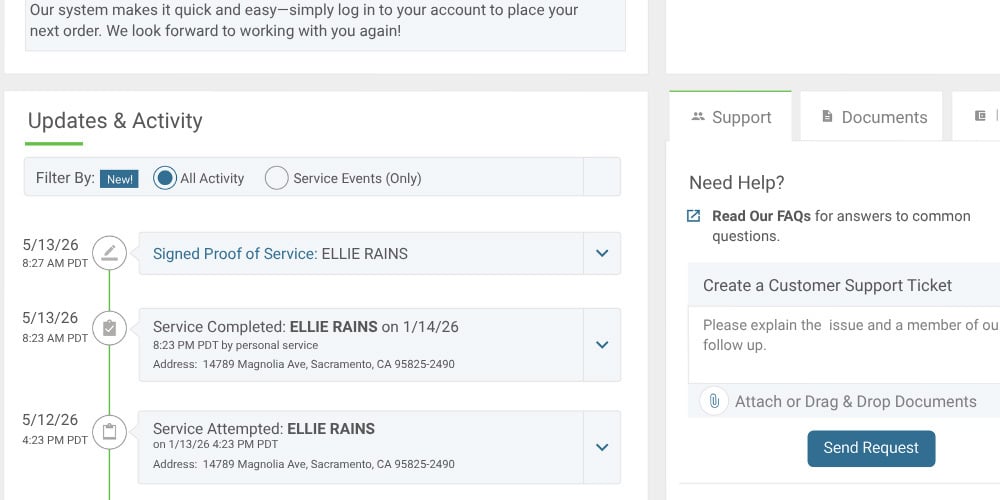
ABC Legal returns a court-ready proof or return of service showing when, where, and how the papers were delivered. It's backed by GPS coordinates and time-stamped notes, available in your secure ABC Legal account.

Ready to serve a family law document?

Upload your documents in under two minutes. We dispatch a registered local server and keep you updated at every attempt.
Questions? Call (206)-521-2885 — Mon-Fri, 7am-4pm PT.