
Serving Eviction Papers

From early notices to post-judgment writs, an eviction can require serving several documents to the parties involved. ABC Legal serves eviction documents nationwide, and 12,000+ vetted local process servers help keep each step on schedule.

How are eviction documents served?

Eviction is the process of forcing a tenant to vacate a property, and it's a multi-step legal process involving a series of official documents, notices, and often time in court. Depending on the state, the lease, and the reason for the eviction, a case may involve any or all of a pay-or-quit demand, a notice to terminate, a court filing, a post-judgment writ, and more, and the requirements attached to each vary. As a rough guide, pre-suit notices are the most flexible, and while a server often isn't required, using one creates cleaner proof if the case is later challenged; documents filed with the court require service of process, and post-judgment writs may be served by an officer. The court sets the specifics.

Before the case

Pre-suit notices

Before going to court, landlords are normally required to give tenants some form of written notice. The name and content vary by state, city, and reason: a notice to quit, pay-or-quit, cure-or-quit, or unconditional quit tells the tenant to resolve the issue, such as overdue rent or a lease violation, or leave. In states such as Texas, Washington, California, and Florida the statutes name no required server, so the landlord or their agent may deliver it. Using a process server is an option when you want extra documentation, the court requires it, or multiple notices need efficient delivery. If there's no response, the case can proceed to court.

The court case

Court filings

Unlawful detainers are legal actions a property owner may use to formally evict an occupant or reclaim possession of property, and the documents that formalize the complaint and summon the occupant to court must be delivered to the party in question. Each state has its own service-of-process rules for these documents, like summonses and complaints, specific to eviction cases. Some states allow posting on the premises with mailing after documented diligent attempts, though the diligence standards differ; Florida, for example, requires two attempts at least six hours apart prior to posting. Some states are stricter: in Texas, only a sheriff or constable may serve an eviction citation.
After court, a writ of possession or restitution may be needed to complete the eviction, and that writ is normally executed by the sheriff, constable, or marshal.
The Basics

Why papers need to be served, and who can do it

State_Process_Attempt_D

What is service of process?

The formal delivery of legal documents to a party in a lawsuit. It is not the same as mailing someone a copy. Service follows rules set by the court, and it has to be documented in a way the court will accept.
State_Process_Attempt_CA

Why do papers have to be served?

Due process. A court cannot enter a binding judgment against someone who was never properly notified of the case. Service is what gives the court personal jurisdiction—and defective service can get a judgment vacated years later.

State_Process_Capture_D

Who can serve my papers?

It depends on the court. Some require a registered or court-appointed process server, or a sheriff. Others allow any adult who is not a party to the case. Using someone unqualified is one of the most common reasons service gets challenged.

What we serve

Every kind of eviction

The variations we see most often across the millions of documents we serve each year.
12,000+ registered servers
SOC2 Type II compliant
DOJ contract since 2003

RULES AND PROCESS EXPERTS

Example eviction rules, state by state

A few examples of how eviction service works by state — ABC serves nationwide, in all 50 states.
California Statewide
Law details
Section 1162 gives three methods for the 3-day, 30-day, or 60-day notice, and the landlord may serve it themselves: personal delivery to the tenant; if the tenant is away from home and work, leaving a copy with a person of suitable age and discretion at either place plus mailing; or, only if residence and business cannot be ascertained, affixing a copy in a conspicuous place, delivering a copy to a person residing there if one can be found, and mailing a copy. The unlawful detainer summons may be served by any person at least 18 who is not a party, and no registered process server is required—though service of the prejudgment claim of right to possession is limited to a marshal, sheriff, or registered process server. Posting the summons requires a court order on an affidavit of reasonable diligence, followed by certified mail, with service complete on the tenth day. Only the sheriff or marshal enforces the writ of possession.
Florida Statewide
Law details
The 3-day rent demand and 7-day cure notices are delivered by the landlord—section 83.56(4) permits mailing, delivering a true copy, emailing where authorized, or leaving a copy at the residence if the tenant is absent. For the eviction summons and complaint, section 48.183 authorizes posting: if the tenant cannot be found in the county or no one 15 or older is at the usual abode after at least two service attempts a minimum of six hours apart, the summons may be served by attaching a copy to a conspicuous place on the property. When serving solely by posting, the landlord gives the clerk an extra copy and a stamped envelope and the clerk mails it first class, with at least five days before final removal. Only the sheriff executes the writ of possession, after 24 hours' notice posted conspicuously, with weekends and holidays not extending the 24 hours.
New York Statewide
Law details
Section 735 is the nail-and-mail statute and it applies to the notice of petition and petition, not just the predicate notice: personal delivery to the respondent; or, if on reasonable application admittance can be obtained and a suitable person found, delivery to a person of suitable age and discretion residing or employed at the property; or, if neither is possible, affixing a copy to a conspicuous part of the property or placing it under the entrance door. Substituted and conspicuous-place service must be followed within one day by mailing both by registered or certified mail and by regular first class mail, and service is complete only on filing proof of service. Any person 18 or older who is not a party may serve, but New York City requires an individual process server license and a separate agency license for anyone serving five or more process per year. The warrant of eviction is executed only by the sheriff, a city marshal, or a constable, after at least 14 days' written notice.
Texas Justice Courts Statewide
Law details
The landlord serves the notice to vacate themselves—section 24.005(f) allows personal delivery to the tenant or to anyone at the premises 16 or older, affixing the notice to the inside of the main entry door, or regular, registered, or certified mail. The eviction citation is different: only a sheriff or constable may serve it, by delivery to the defendant or to someone over 16 at the residence at least six days before trial. After two documented diligent attempts the judge may authorize delivery to the premises—through the mail chute, under the front door, or affixed to the front door—plus first class mail. The writ of possession must be executed by a sheriff or constable, who posts a 24-hour written warning on the exterior front door before removing occupants.
Washington Statewide
Law details
The termination or pay-or-vacate notice is served by personal delivery; or, if the tenant is absent, by leaving a copy with a person of suitable age and discretion and mailing a copy; or, if no such person can be found, by affixing a copy in a conspicuous place on the premises, delivering a copy to anyone residing there if found, and mailing a copy. Mail service adds five days before suit can be filed, and the landlord or their agent may serve the notice. The eviction summons and complaint are served the same as a summons in other actions, so any competent non-party over 18 may serve. A landlord who fails personal service after documented diligent attempts may post the summons and complaint and mail copies by both regular and certified mail, but that limits the court to possession only, with no money judgment. Only the sheriff serves and executes the writ of restitution.
These are examples, not a complete list. The information on this page is provided for general informational purposes only and is not legal advice. Statutes and court rules change, and their application varies by case and venue — verify current requirements with the applicable court or consult a licensed attorney. Statutory references on this page were last reviewed September, 2026.

See your price for service of process

With flat-rate pricing and nationwide coverage, it's easy to see what service of process will cost. Select your state to get started.

Select your state*

Or click any state on the map.

  • Preferred Partner of Wolters Kluwer / CT Corp
  • Exclusive contract with the U.S. Dept. of Justice since 2003
  • Chosen by 50,000+ legal professionals

Some markets require wet ink and may take additional time. Final price available during checkout.

Working against a filing deadline?

Priority moves your serve up the queue — first attempt within 3 days, for $30 more per party.

Commonly asked questions

Eviction FAQs

What is service of process?
Service of process is the formal delivery of legal documents to a party in a lawsuit, using a method authorized for the case. The delivery must follow the applicable rules and be documented in a way the court will accept, or it may not count. ABC Legal handles both the delivery and the proof that goes with it, helping you get service done right the first time.
Why do papers have to be served?
It comes down to due process: parties need proper notice of a case and an opportunity to respond. Valid service of process helps establish the court's authority over the defendant, and defective service can cause a case to stall or put a judgment at risk. ABC Legal makes service provable, with documented proof of who was served, when, where, and how.
Who can serve my papers?
It depends on the jurisdiction and the type of papers being served. Some require a registered or court-appointed process server or a sheriff, while others allow any adult who isn't a party to the case to make the delivery. Using someone who doesn't qualify can make the service subject to challenge, so ABC Legal uses vetted process servers who meet applicable requirements, with more than 12,000 of them across the country.
How is an eviction served?
An eviction usually moves through several documents: a pre-suit notice, the court filing (an unlawful detainer summons or citation), and, after judgment, a writ of possession. Each one has its own rules about who can serve it and how, and the deadlines are short. ABC Legal matches service to each document and each state and keeps the whole sequence on track.
Can a landlord serve the eviction notice themselves?
For the pre-suit notice, usually yes. Most states name no required server for a notice to vacate or pay-or-quit, so a landlord can deliver it, though using a process server creates cleaner proof if the case is later challenged. The court filing that follows is genuine service of process with stricter rules, and that's where ABC Legal typically takes over.
Who serves an eviction in Texas?
Texas is the strict exception. Only a sheriff or constable may serve an eviction citation, even though certified process servers can serve most other Texas documents. ABC Legal supports that officer service with coordination, status updates, and tracking, so you're not left in the dark waiting on the county.
Who executes the writ of possession?
The sheriff, constable, or marshal executes the writ of possession, and a private process server can't remove a tenant. Timing rules vary, such as 24 hours of posted notice in Florida and at least 14 days in New York. ABC Legal coordinates that officer service and tracks it through completion.
What proof do I get?
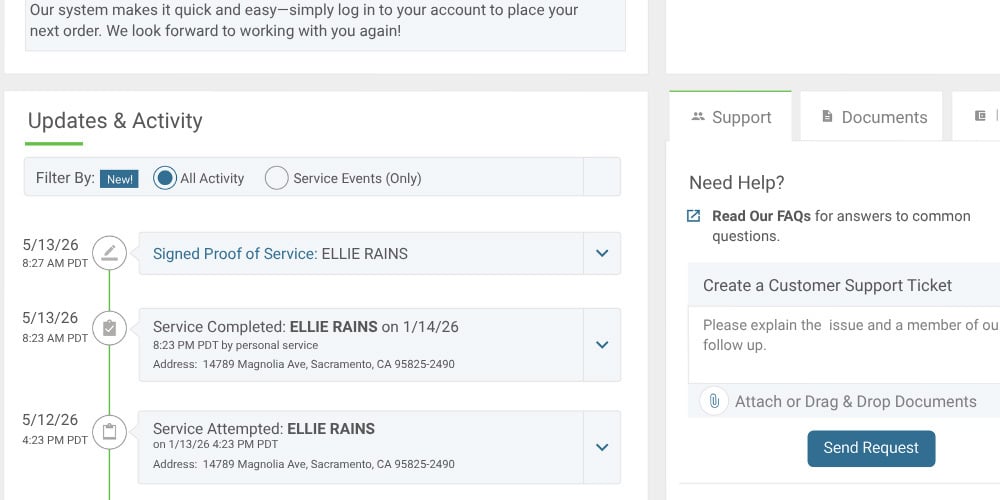
ABC Legal documents and returns proof for each step it serves, from the pre-suit notice through the court filing, formatted for your court and backed by GPS and time-stamped notes. It's all available in your secure ABC Legal account.

Ready to serve an eviction?

Upload your documents in under two minutes. We dispatch a registered local server and keep you updated at every attempt.
Questions? Call (206)-521-2885 — Mon-Fri, 7am-4pm PT.