
Serving a Citation

A citation does the same job as a summons: it tells someone a case has started and sets the deadline to respond. ABC Legal knows the rule in each and serves citations nationwide through 12,000+ vetted local process servers.

What is a citation?

A citation is the instrument a court uses to notify a person or entity that a proceeding involving them has begun and to state the deadline to respond. Texas and Louisiana use citations in place of a summons in ordinary civil suits, and probate and guardianship courts in several states issue citations to interested parties. The document does the same job as a summons. The difference is the terminology, the form, and often the rules about who may serve it.

The instrument

Citation

The citation is issued by the clerk under the court's seal, names the parties and the court, and states the deadline to answer. It is what gives the court authority over the person or entity named, so a defect in the citation or in how it was served can undo everything that follows.

The delivery

Service

Service is the act of getting the citation into the right hands in a way the court will accept. The authorized method and the authorized server both come from state law. Texas allows a JBCC-certified process server for most civil citations, while Louisiana routes service through the sheriff unless a court appoints someone else.
Terminology varies by state. Texas and Louisiana issue citations in civil suits, while most other states issue a summons. If a citation is issued in response to an initiating claim such as a petition, both documents often must be served together to be effective.
The Basics

Why papers need to be served, and who can do it

State_Process_Attempt_D

What is service of process?

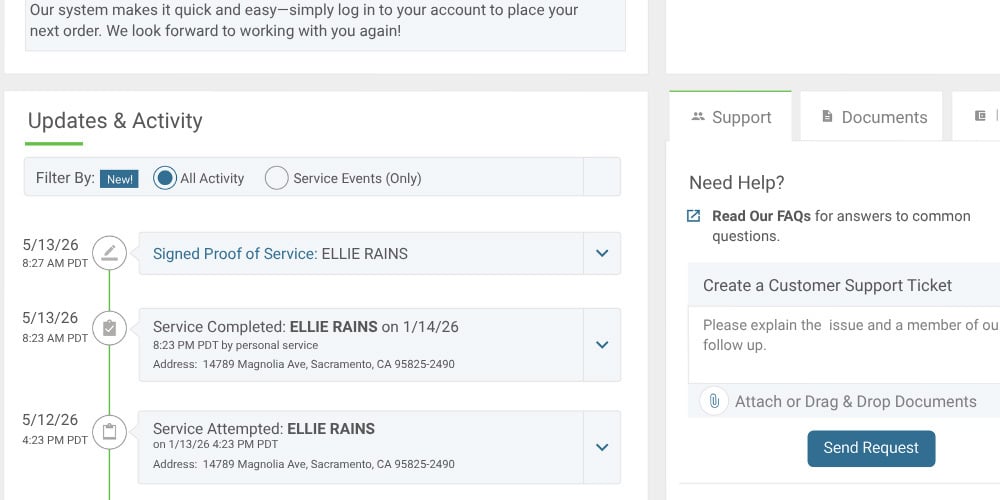
The formal delivery of legal documents to a party in a lawsuit. It is not the same as mailing someone a copy. Service follows rules set by the court, and it has to be documented in a way the court will accept.
State_Process_Attempt_CA

Why do papers have to be served?

Due process. A court cannot enter a binding judgment against someone who was never properly notified of the case. Service is what gives the court personal jurisdiction—and defective service can get a judgment vacated years later.

State_Process_Capture_D

Who can serve my papers?

It depends on the court. Some require a registered or court-appointed process server, or a sheriff. Others allow any adult who is not a party to the case. Using someone unqualified is one of the most common reasons service gets challenged.

What we serve

Every kind of citation

The variations we see most often across the millions of documents we serve each year.
12,000+ registered servers
SOC2 Type II compliant
DOJ contract since 2003

RULES AND PROCESS EXPERTS

Example citation rules, state by state

A few examples of how citation service works by state — ABC serves nationwide, in all 50 states.
Louisiana Statewide
Law details
Citation and service of it are essential in nearly every Louisiana civil action—without them all proceedings are absolutely null—and service must be requested on all named defendants within 90 days of commencement. Article 1291 provides that except as otherwise provided by law, service is made by the sheriff of the parish where service is to be made or where the action is pending. A private person may serve only by court appointment on motion, and only after the sheriff has failed to serve within ten days of receiving the process or has returned it certifying he could not serve.
Massachusetts Probate and Family Court Statewide
Law details
In formal probate and guardianship proceedings the court fixes a return date and issues a citation, and the petitioner is then responsible for giving notice. Section 1-401(a) provides three methods: mailing a copy at least 14 days before the return date by certified, registered, or ordinary first class mail to interested persons who have not assented in writing; delivering a copy to the person personally at least 14 days before the return date; or publishing it once, at least 7 days before the return date, in a newspaper designated by the register of probate. Proof of notice must be filed on or before the return day.
New York Surrogate's Court Statewide
Law details
A Surrogate's Court proceeding opens with a citation returnable on a fixed date. Section 310 allows any person over 18 to serve process within the state, including a party, with no sheriff involvement, and out-of-state personal service follows CPLR 313. As amended in 2025, section 307(2) allows service by registered mail, certified mail, or special mail service within or outside the state, including on New York domiciliaries, with no court order required. Court-ordered alternative service now expressly includes electronic means, available only on a showing of due diligence or impracticability.
Texas Statewide
Law details
Under Rule 99 the clerk issues the citation on request, styled "The State of Texas" and signed under seal, and the party requesting it is responsible for obtaining service; the citation directs the defendant to answer by 10:00 a.m. on the Monday after 20 days from service. Rule 103 allows service anywhere by a sheriff or constable, by a person authorized by written court order, or by a process server certified by the Judicial Branch Certification Commission; service by registered or certified mail and citation by publication must be made by the clerk. Rule 106(a) permits in-person delivery or registered or certified mail, return receipt requested, and Rule 106(b) lets the court authorize service by other means on a sworn showing that both failed—including electronically by social media, email, or other technology. Rule 107 requires the return to include the server's certification number and expiration date.
Texas Probate and Guardianship Courts Statewide
Law details
The county clerk issues probate citations without a court order. Personal service must first be attempted on the person's attorney of record; if there is none or that fails, a sheriff or constable delivers the citation in person when the person is in Texas, and a disinterested person competent to make an oath may serve only when the person is absent from or not a resident of Texas. The clerk also serves by regular mail, or by a qualified delivery method at least 20 days before the return day; posting is done by a sheriff or constable at the courthouse, and publication runs on the Office of Court Administration site and in a newspaper.
These are examples, not a complete list. The information on this page is provided for general informational purposes only and is not legal advice. Statutes and court rules change, and their application varies by case and venue — verify current requirements with the applicable court or consult a licensed attorney. Statutory references on this page were last reviewed September, 2026.

See your price for service of process

With flat-rate pricing and nationwide coverage, it's easy to see what service of process will cost. Select your state to get started.

Select your state*

Or click any state on the map.

  • Preferred Partner of Wolters Kluwer / CT Corp
  • Exclusive contract with the U.S. Dept. of Justice since 2003
  • Chosen by 50,000+ legal professionals

Some markets require wet ink and may take additional time. Final price available during checkout.

Working against a filing deadline?

Priority moves your serve up the queue — first attempt within 3 days, for $30 more per party.

Commonly asked questions

Citation FAQs

What is service of process?
Service of process is the formal delivery of legal documents to a party in a lawsuit, using a method authorized for the case. The delivery must follow the applicable rules and be documented in a way the court will accept, or it may not count. ABC Legal handles both the delivery and the proof that goes with it, helping you get service done right the first time.
Why do papers have to be served?
It comes down to due process: parties need proper notice of a case and an opportunity to respond. Valid service of process helps establish the court's authority over the defendant, and defective service can cause a case to stall or put a judgment at risk. ABC Legal makes service provable, with documented proof of who was served, when, where, and how.
Who can serve my papers?
It depends on the jurisdiction and the type of papers being served. Some require a registered or court-appointed process server or a sheriff, while others allow any adult who isn't a party to the case to make the delivery. Using someone who doesn't qualify can make the service subject to challenge, so ABC Legal uses vetted process servers who meet applicable requirements, with more than 12,000 of them across the country.
What is the difference between a citation and a summons?
They do the same job: telling a party that a proceeding has started and setting the deadline to respond. Texas and Louisiana use a citation instead of a summons in ordinary civil suits, and several states issue citations in probate and guardianship matters. The rules about who may serve a citation often differ from the summons rules, which is why ABC Legal tracks the requirements state by state.
How is a citation served?
It depends on the state. Texas allows a certified process server for most civil citations, while Louisiana routes service through the sheriff unless the court appoints someone else, and probate courts add their own requirements. ABC Legal knows the authorized method and the authorized server in each place and handles the citation the right way so it holds up in court.
Do you serve probate and guardianship citations?
Yes. ABC Legal serves probate, guardianship, and Surrogate's Court citations that bring interested parties into an estate or guardianship proceeding. These serves call for a careful, discreet approach, since the person served may be elderly or incapacitated, and some states require a sheriff or constable for in-state delivery, which ABC Legal coordinates where it's needed.
What if the defendant can't be found?
ABC Legal documents diligent attempts and uses skip tracing to locate a hard-to-find defendant. If the person still can't be located after a genuine search, the court may authorize citation by publication, but usually only once those diligent-search attempts are on record, which is exactly the documentation ABC Legal provides.
What proof do I get?
ABC Legal returns a court-ready return of service showing when, where, and how the citation was delivered, formatted for your court and backed by GPS and time-stamped notes from the attempt. You can download it from your secure ABC Legal account.

Ready to serve a citation?

Upload your documents in under two minutes. We dispatch a registered local server and keep you updated at every attempt.
Questions? Call (206)-521-2885 — Mon-Fri, 7am-4pm PT.